

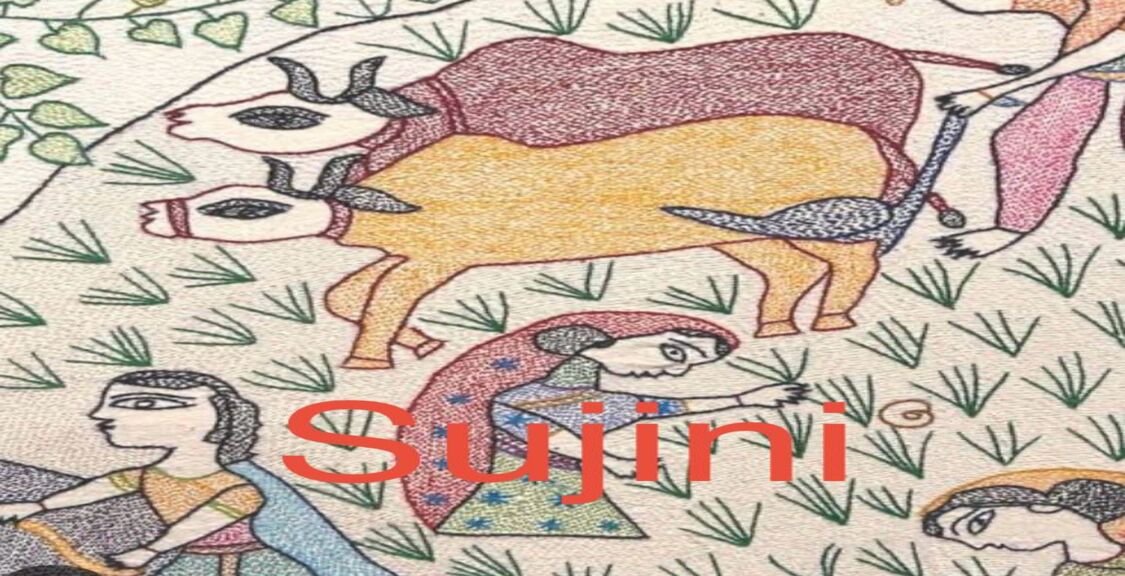
India is home to countless traditional art forms, many of which remain quietly preserved in villages across the country. One such beautiful and meaningful craft is Sujini embroidery, a traditional art form from Bihar that tells stories through simple hand stitches.
The Origin of Sujini
Sujini embroidery originated in Bhusura village in the Muzaffarpur district of Bihar during the early 20th century. It was developed by village women who used layers of old sarees and dhotis to create quilts for newborn babies.
The word “Sujini” itself refers to a quilt prepared for infants. These quilts were stitched together using a basic running stitch — a simple technique that required patience and dedication rather than elaborate tools.
What began as a functional household practice gradually evolved into a powerful artistic expression.
From Quilts to Storytelling
Over time, Sujini embroidery moved beyond newborn quilts. Women began using the same running stitch technique to depict scenes from:
- Daily village life
- Folklore and traditions
- Nature and animals
- Social themes and emotions
Each piece became a visual narrative. Through thread and fabric, women expressed their experiences, surroundings, and stories.
Unlike machine embroidery, Sujini carries visible irregularities — slight variations in stitch length and pattern. These imperfections are not flaws; they are proof of handmade authenticity.
Recognition and GI Tag
Sujini embroidery has received the prestigious UNESCO Seal of Excellence, recognizing its craftsmanship and cultural authenticity. It is also GI-tagged (Geographical Indication), which protects its origin and ensures that the craft remains linked to its traditional roots in Bihar.
Today, Sujini is practiced in approximately 15 villages around Bhusura and in parts of Madhubani district, keeping this heritage alive through generations of women artisans.
Why Sujini Matters Today
In a world dominated by fast fashion and mass production, Sujini reminds us of the value of slow craftsmanship.
Every stitch is done by hand.
Every design carries emotion.
Every piece reflects time and patience.
Supporting such crafts means preserving culture, empowering rural women, and encouraging sustainable production methods.
Sujini at Eternal Pehnawa
At Eternal Pehnawa, we believe in celebrating crafts that carry history and meaning. Sujini embroidery represents simplicity, storytelling, and heritage — values that align deeply with our vision.
When you choose a Sujini piece, you are not just choosing embroidery.
You are choosing tradition, patience, and a story stitched by hand.
Add comment